Admissions open for the 2026-27 session. How admission works

Thirteen levels, Play Group to Grade 8

Spring Buds School teaches all 13 levels in English, Play Group to Grade 8, at one building in Federal B Area Block 11, Gulberg Town, Karachi.

Lessons are activity based and project based. A child sorts the thing, builds it, acts it out or explains it to the class, and the writing comes after that. Every level below carries what it covers and the sort of work a week in it holds.

if the right level is not obvious from the names. It is worked out from a date of birth, and from the last report card when a child is moving school.

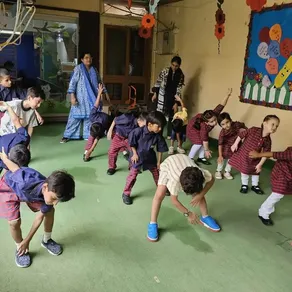
Montessori children stretch together during a morning exercise session
Montessori children at the start of the session, August 2026.

The Montessori years

Play Group, Pre Nursery, Nursery and Montessori

Four years, and the last of them gives the stage its name. Almost none of the work is handed out here: a child picks it, and finishing it is half of what is being taught.

PG

Play Group

Montessori stage

The first year at Spring Buds School and the start of the Montessori stage. Days are built around talking, singing, moving and handling real things, with English spoken from the first morning. Much of the year is simply settling in, which is work in itself when you are new to a building full of other children.

  • Settling into a school morning
  • Spoken English and listening
  • Large movement and balance
  • Colours, shapes and sounds
  • Rhymes and action songs in a circle
  • Sand, water and dough at a shared table
  • Story time with questions afterwards
  • Free play in the covered area

PN

Pre Nursery

Montessori stage

The second Montessori year, where the hand starts to catch up with the mouth. Children hold a pencil properly, trace pre-writing patterns, sort and match, and meet the first letter sounds. Counting is done with objects on a table before it is ever done on a worksheet.

  • Pencil control and pre-writing patterns
  • First letter sounds
  • Counting with real objects
  • Sorting and matching
  • Tracing patterns on large sheets
  • Threading beads, pegging cards and posting shapes
  • Sound of the week hunts around the room
  • Counting games with buttons and blocks

N

Nursery

Montessori stage

Phonics turns into reading here. Children blend sounds into short words, form letters on a line, write numbers past ten, and answer questions about a story rather than only listening to one. Show and tell puts each child in front of the class to speak.

  • Blending sounds into words
  • Letter formation on a line
  • Numbers past ten
  • Speaking in front of the class
  • Word building with sound cards
  • Show and tell
  • Number lines and object counting
  • Craft work tied to the topic of the week

M

Montessori

Montessori stage

The last of the four early years, worked mostly with prepared materials. A child chooses a piece of work, carries it to a mat, finishes it and puts it back, which is how independence gets taught here rather than talked about. Early reading, writing and number work run alongside practical life.

  • Choosing and finishing a piece of work
  • Practical life and sensorial materials
  • Early reading and writing
  • Number work with concrete materials
  • Pouring and spooning work, and the buttoning frames
  • Sandpaper letters and movable alphabet
  • Number rods and bead work
  • Tidying the material away before the next one

The primary section

Kindergarten, then Grade 1 to Grade 5

Six levels. Kindergarten turns the work formal, and by Grade 5 a child has to be ready for subject teachers.

KG

Kindergarten

Primary

The year the work turns formal, and the first year of the primary section. Children read simple books on their own, write sentences instead of single words, and handle numbers to a hundred with addition and subtraction. English, Urdu, Islamiyat and general knowledge appear as named subjects.

  • Reading simple books unaided
  • Writing full sentences
  • Numbers to a hundred
  • Named subjects and a timetable
  • Reading aloud in small groups
  • Sentence writing about a picture
  • Addition and subtraction with counters
  • Class assembly items

1

Grade 1

Primary

The first full year of the primary section, with English, Mathematics, Science, Urdu, Islamiyat and Social Studies as separate subjects. Children read short passages and answer questions on them in writing, learn place value and number bonds, and keep their own notebooks.

  • Reading comprehension in writing
  • Place value and number bonds
  • Keeping a notebook properly
  • Science by doing, then recording
  • Comprehension passages with written answers
  • Number work with base ten materials
  • Simple science activities at the table
  • Handwriting practice every day

2

Grade 2

Primary

Handwriting, tables and paragraphs. Children move from single sentences to short paragraphs in English and in Urdu, learn the multiplication tables and the operations built on them, and record what happened in a science activity instead of only watching it.

  • Short paragraphs in English and Urdu
  • Multiplication tables
  • Recording a science activity
  • Neat, legible handwriting
  • Paragraph writing on a set topic
  • Tables drill and word problems
  • Group science activities with a written record
  • Reading aloud from the class reader

3

Grade 3

Primary

Where the writing starts to be worth reading. Children plan a piece before they write it, work with multiplication, division and fractions, and take on projects that run across more than one lesson. Students from Grade 3 were among those recognised as Young Peace Advocates at Create for Peace 2026.

  • Planning a piece before writing it
  • Fractions, multiplication and division
  • Project work across several lessons
  • Creative writing
  • Story and poem writing for competitions
  • Group projects with a presentation at the end
  • Science fair project planning
  • Map and diagram work in Social Studies

4

Grade 4

Primary

Longer pieces and harder sums. Children write structured essays and letters, work with decimals, area and larger numbers, and read for information as well as for a story. Students from Grade 4 were among those recognised as Young Peace Advocates at Create for Peace 2026.

  • Structured essays and letters
  • Decimals, area and larger numbers
  • Reading for information
  • Creative writing
  • Essay and letter writing to a plan
  • Measuring and calculating area in class
  • Science fair projects built at home and shown at school
  • Entrepreneurship day stalls

5

Grade 5

Primary

The last year of the primary section, and the year that has to get children ready for subject teachers. They take notes, revise from those notes, and sit longer papers. Science moves from watching a demonstration to running the activity and writing up what happened.

  • Taking notes and revising from them
  • Longer written papers
  • Running a science activity, not watching one
  • Working to a deadline
  • Note taking from the board and from a text
  • Timed practice papers
  • Science fair projects with a written method
  • Entrepreneurship day stalls

The middle section

Grade 6, Grade 7 and Grade 8

Three years on a full timetable, taught by subject teachers. Grade 8 is the last level the school runs.

6

Grade 6

Middle

The first year of the middle section, taught by subject teachers. Mathematics moves into algebra and geometry, Science separates into physics, chemistry and biology topics, and written English is marked for structure as much as for spelling. Students from Grade 6 were among those recognised as Young Peace Advocates at Create for Peace 2026.

  • Subject teachers and a full timetable
  • Algebra and geometry
  • Physics, chemistry and biology topics
  • Structure in written English
  • Practical work in science with a written method
  • Essay and creative writing for competitions
  • Science fair and entrepreneurship day projects
  • Presentations to the class

7

Grade 7

Middle

The year in the middle of the middle section, and the one where habits stick. Students plan and redraft their own written work, handle equations, ratio and proportion, and design the method for a practical rather than being handed one. Urdu, Islamiyat and Social Studies carry a real reading load by now.

  • Planning and redrafting written work
  • Equations, ratio and proportion
  • Designing a method for a practical
  • Reading load in Urdu and Social Studies
  • Redrafting an essay after marking
  • Practical work students set up themselves
  • Science fair and entrepreneurship day projects
  • Debates and class presentations

8

Grade 8

Middle

The last year the school runs, and it is aimed squarely at leaving here able to sit in a Grade 9 room without catching up. Extended writing, algebra and geometry together, science with numbers in it, and revision done properly instead of the night before.

  • Extended writing under time
  • Algebra and geometry together
  • Science with calculation in it
  • Revision technique
  • Full length practice papers
  • Independent project work start to finish
  • Science fair and entrepreneurship day projects
  • Leading parts of the annual function programme

How is a lesson actually taught?

Activity first, then the writing.

In Pre Nursery, counting happens with buttons and blocks on a table long before a worksheet asks for a number. In Nursery a child blends sounds out loud, then stands in front of the class at show and tell. By Grade 3 a piece of writing is planned before it is started, and a project carries on past the lesson it began in. In Grade 7 students work out the method for a practical rather than being handed one. The order does not change from one end of the school to the other: handle it, then record it.

What is taught in English, and what is not

English is the medium from the first morning in Play Group. Lessons, books, written work and assemblies run in English, while Urdu and Islamiyat are taught as named subjects in their own language from Kindergarten onwards. Grade 6 hands the timetable to subject teachers, and science splits into physics, chemistry and biology topics from that year.

Why writing is the hard part here

Miss Fareeha Kanwal, who started the school in 2018, teaches A Levels English at Nixor College, The City School PAF Chapter and Highbrow College. Writing is her subject, and it shows in what gets asked of a piece of written work here. Children plan before they write from Grade 3, redraft after marking from Grade 7, and sit extended writing under time in Grade 8.

Where the work ends up

Three places it shows up outside the notebook.

A competition somebody else runs

At Create for Peace 2026, organised by MindCarver, our students took Silver and Bronze in the Creative Writing category, and several were recognised as Young Peace Advocates. Students from Grade 3, Grade 4 and Grade 6 were among them. The medals were handed over at our prize distribution on 3 June 2026.

Those results are read off the printed backdrops in our own photographs of that evening. We publish no names and no winner counts. The originals are on Facebook.

On a stage in early June

The session closes with the annual function and then the prize distribution. The function runs in a hall away from the school, with a stage and a lit backdrop, and Grade 8 leads parts of the programme.

The traditions and the dated occasions are on the events page.

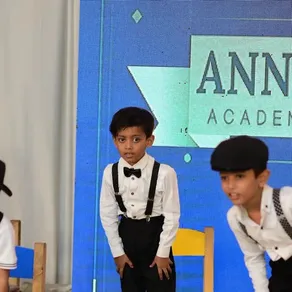
Students perform in front of the Annual Function stage backdrop
On stage at the annual function, 3 June 2026.

Projects that leave the classroom

The science fair and entrepreneurship day are the two traditions built on project work. A science fair project gets built before it gets explained, and on entrepreneurship day the children who run a stall are the ones who costed it.

What a day here looks like

Tell us the date of birth

No age table appears on this page, because no single table would fit every child. The level is worked out one family at a time, and the answer comes back in a message rather than off a chart.

Send us
A date of birth. If your child has been at school before, the class they finished and the last report card.
We send back
The level, and the list of documents that goes with it.
Then come and look
A weekday morning at the school in Federal B Area Block 11, while lessons are running. Monday to Friday, 8:00 AM to 1:30 PM.

How a visit turns into a confirmed seat is on the admissions page. If the fee is what is holding this up, the scholarships page sets out how a family asks.

Message us on WhatsApp